
For more than a decade, the DeFi sector has operated on a fractured promise. The theoretical pitch of a fairer, more accessible global financial system has consistently crashed against the rocks of practical reality. In practice, DeFi has delivered a user experience defined by hostility of confusing interfaces, punitive gas fees, risky workflows, and the …

For more than a decade, the DeFi sector has operated on
a fractured promise. The theoretical pitch of a fairer, more accessible global financial system has
consistently crashed against the rocks of practical reality.
In practice, DeFi has delivered a user experience defined by hostility of confusing interfaces, punitive gas
fees, risky workflows, and the terrified clutching of seed phrases. It created a system where only the
technically literate or those willing to take risks dared to tread, leaving the vast majority of the world’s
savers on the sidelines.
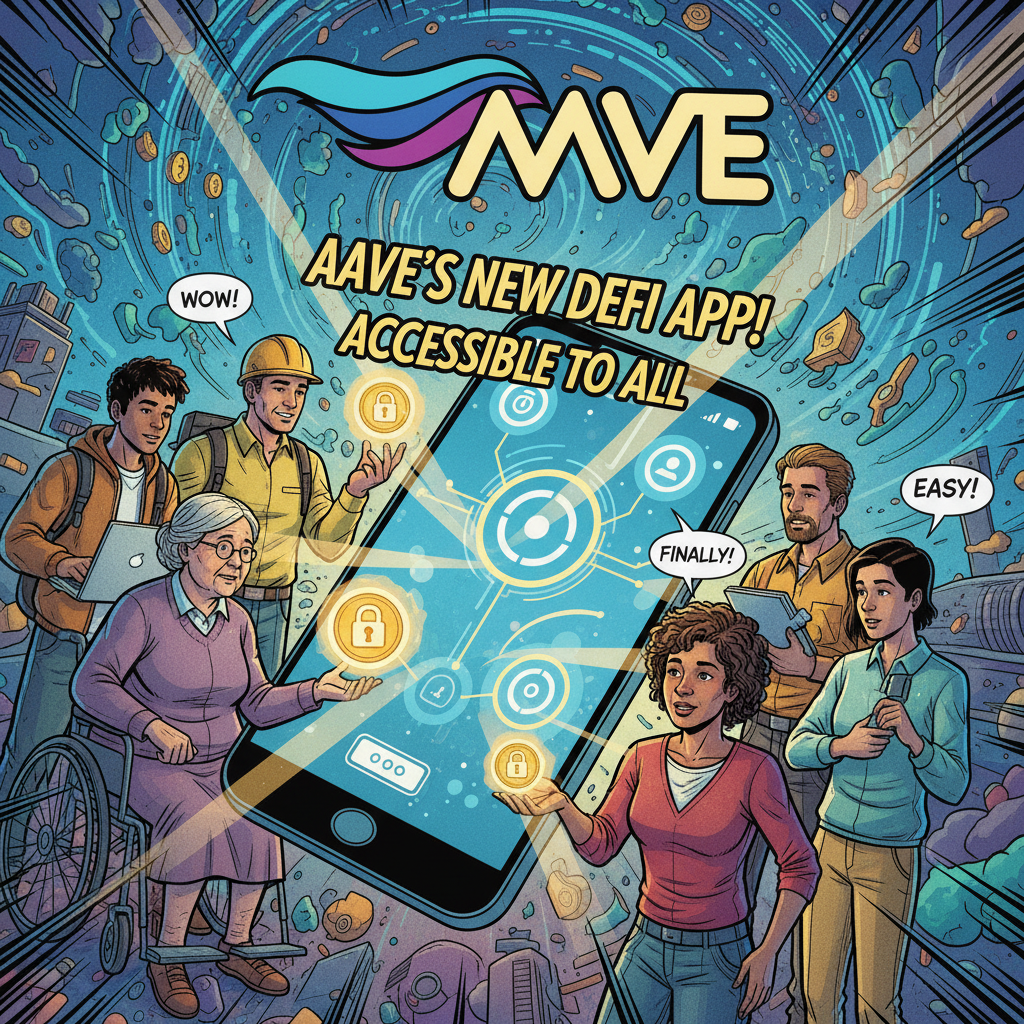
But the launch of Aave’s
new mobile savings application marks a distinct departure from this exclusionary history.
By radically re-engineering the user journey to mimic the seamlessness of modern fintech, Aave is making a
strategic wager that the path to onboarding a billion users isn’t about teaching them to navigate the
blockchain, but about making the blockchain entirely invisible.
The end of the “Tech Tax”
The most formidable barrier to DeFi adoption has never been the lack of yield; it has been the abundance of
friction.
The “tech tax” of the ecosystem, requiring users to manage browser extensions like MetaMask, navigate complex
signing pop-ups, and calculate gas fees in Ethereum, effectively capped the market size at power users.
The Aave App represents a fundamental break with this pattern. Leveraging advanced account abstraction, the
application removes the vestiges of crypto’s technical burden.
There are no ledger devices to connect, no hexadecimal wallet addresses to copy and paste, and no manual
bridging of assets between disparate chains. The interface simply asks the user to save.
This way, users can deposit euros, dollars, or connect debit cards, and the protocol handles the backend
complexity of converting fiat into yield-bearing stablecoins.
By stripping away the “crypto” aesthetics and presenting itself as a clean, neo-banking interface, Aave is
targeting the demographic that Revolut and Chime captured: digital natives who want utility without technical
overhead.
A bank-like experience
The structural ambition of the app is to function as a bank in the front and a decentralized liquidity engine
in the back.
This is not a trivial pivot. Aave currently manages over $50 billion in assets through smart contracts. If
structured as a traditional financial institution, its balance sheet would rank it among the top 50 banks in
the United States.

However, unlike traditional banks, where liquidity is often opaque, Aave’s ledger is transparent and
auditable 24/7.
To operationalize this for the mass market, Aave Labs’ subsidiary recently secured authorization as a Virtual
Asset Service Provider (VASP) under Europe’s comprehensive MiCA (Markets in Crypto-Assets) framework.
This regulatory milestone is the linchpin of the strategy. It provides the app with a legally recognized
gateway into the traditional SEPA banking system, enabling compliant and regulated fiat on-and-off ramps.
This moves Aave out of the “shadow banking” categorization and into a recognized tier of financial service
providers, granting it the legitimacy required to court mainstream depositors who would otherwise never touch
a DeFi protocol.
The $1 Million protection
If complexity is the first barrier to entry, trust is the second.
Numerous
exploits, bridge hacks, and governance failures mark the history of DeFi. For the average saver, the
fear of total loss outweighs the allure of high returns. No amount of yield is worth the risk of a drained
wallet.
Aave is attempting to shatter this ceiling by introducing a balance protection mechanism of up to $1 million
per user. This figure quadruples the standard $250,000 insurance limit for FDIC-insured accounts in the US.
While this protection is protocol-native rather than government-backed, the psychological impact is profound.
It signals a shift in responsibility from the retail user to the protocol. In doing so, Aave is
repositioning DeFi from a “buyer beware” frontier experiment into a product with institutional-grade safety
rails.
For a middle-class saver in Europe or Asia, this reframes the proposition from “speculating on crypto” to
“saving with better insurance than my local bank.”
The yield advantage
While protection solves the trust deficit, yield solves the incentive problem.
The macroeconomic timing of Aave’s rollout is fortuitous. As central banks globally, including the Federal
Reserve and the ECB, begin to cut rates, traditional savings yields are projected to compress back toward the
low single digits.
Aave’s yield engine, however, operates on a different fundamental driver.
According to analytics from SeaLaunch, Aave’s
stablecoin APY (denominated in USD and EUR) has consistently outperformed risk-free instruments, such as US
Treasury bills. This is because the yield is derived from on-chain borrowing demand rather than central bank
policy.
This creates a persistent premium. As traditional rates fall, the spread between a bank savings account
(offering perhaps 3%) and Aave (offering 5–9%) widens.

For global users, particularly in developing economies with unstable banking sectors or high inflation, this
access to dollar-denominated, high-yield savings is a necessary financial lifeline and not just a luxury.
The distribution engine
Ultimately, the most understated component of Aave’s strategy is distribution.
By launching on the Apple iOS App Store, Aave is attaching its decentralized rails to the world’s largest
fintech distribution engine. In 2024, the App Store received 813 million weekly visitors across 175 markets,
according to Apple.
Considering this, Sebastian Pulido, Aave’s Director of Institutional & DeFi Business, captured it perfectly by
describing the new application as “DeFi’s iPhone moment” because the platform will “abstract away all
complexity and friction around getting access to defi yields.”
Essentially, just as the browser made the internet accessible to non-coders, the App Store makes DeFi
accessible to non-traders.
Aave is tapping into the same infrastructure that scaled PayPal, Cash App, and Nubank to global dominance.
So, for the first time, a user in Lagos, Mumbai, or Berlin can onboard into DeFi with the same simplicity as
downloading a game. There are no barriers, no distinct “crypto” learning curve, and no friction.
Essentially, if DeFi is ever to reach a billion users, it will not happen through browser extensions or
technical whitepapers. It will happen through an app that looks like a bank, protects like an insurer, and
pays like a hedge fund.