The year opened with a sitting president launching his own token three days before inauguration and closed with researchers proving that one of the year's “comeback stories” was controlled by a few dozen wallets. Between those bookends, 2025 turned memecoins from niche absurdity into crypto's most visible, and most embarrassing, corner. A sovereign leader rugpulled …
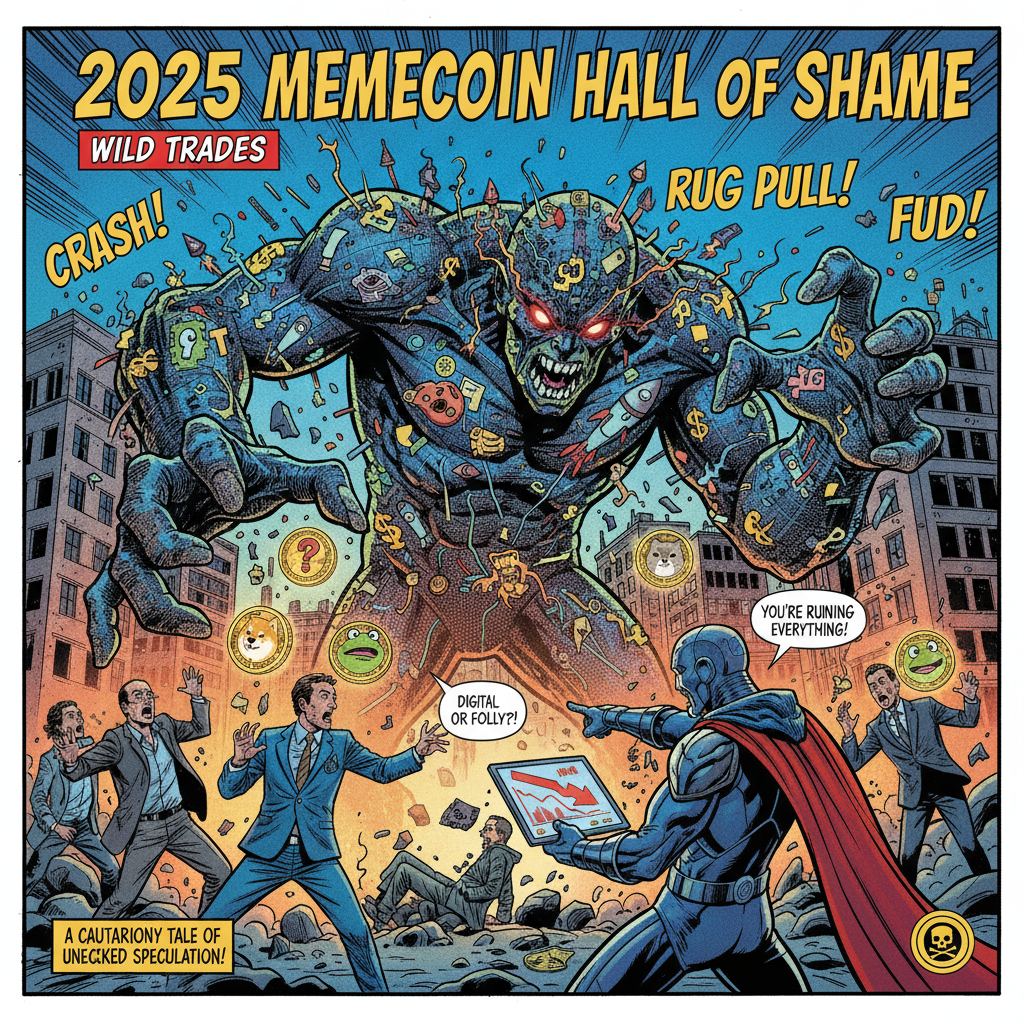

The year opened with a sitting president launching his own token three days
before inauguration and closed with researchers proving that one of the
year’s “comeback stories” was controlled by a few dozen wallets.
Between those bookends, 2025 turned memecoins from niche absurdity into
crypto’s most visible, and most embarrassing, corner. A sovereign leader
rugpulled his citizens on Valentine’s Day, an AI chatbot’s fart jokes
spawned a billion-dollar token, Dogecoin got two regulated ETFs, and the
platform that minted 9.4 million tokens became the year’s de facto
casino.
What made these ten tokens iconic wasn’t quality or innovation, but their
capacity to crystallize everything broken about the meme trade. Together
they traced a narrative arc from political grift through AI-driven mania,
celebrity fiascos, institutional crossover, and late-cycle
manipulation.
TRUMP and MELANIA rekindled PolitiFi
On Jan. 17, three days before President
Donald Trump’s
second inauguration, the
TRUMP
token launched on the Solana blockchain. One billion coins were created,
and Trump-linked companies retained 800 million.
 #60
#60
Official TrumpTRUMP
$4.93555
+0.01%
Market Cap$987.11M
24h Volume$135.24M
All-Time High$17.5596
Sectors
Two days later,
MELANIA
went live, hitting $2 billion in market cap within hours. Together, they
created the template for “official” political memecoins and
sparked ethics debates
about whether a sitting president should monetize his position through
crypto tokens.

below $5.
TRUMP and MELANIA mattered because they formalized political memecoins as
a product category. These tokens were endorsed by the principals
themselves, with no pretense of utility, just pure monetization of
political brand equity.
US lawmakers questioned the conflict of interest, but no enforcement
materialized. The precedent stood: if you control enough attention, you
can launch a token, keep most of the supply, and let the market decide
legality.
As of Dec. 23, TRUMP and MELANIA are down by over 99% since their peaks.

falling from around $14 to $0.10 by late 2025.
LIBRA turns the trade into a sovereign scandal
On Feb. 14, Argentina’s President Javier Milei posted the LIBRA contract
address and urged citizens to buy in. The token jumped from $0.000001 to
roughly $5.20 in 40 minutes, and hit $4.6 billion in market cap.
However,
LIBRA crashed 85% within hours
as insiders dumped 70% of the supply. By Feb. 18, the press called it
“Cryptogate,” investors filed criminal complaints, and opposition parties
pushed for impeachment.
LIBRA mattered because it proved PolitiFi could go catastrophically wrong
at the state level. Milei crossed the line with direct endorsement,
creating the appearance of official backing while insiders positioned to
exit.
The crash destroyed wealth and handed Milei’s opponents a scandal. It also
killed memecoin risk appetite for months. Regulators cited LIBRA as
evidence that celebrity and political endorsements create unacceptable
consumer harm.
As of press time, LIBRA is 98.5% down from its peak.
FARTCOIN and the AI meme revival
FARTCOIN
emerged in April as a
Solana
memecoin born from the Truth Terminal AI chatbot, combining fart jokes and
internet culture. By June, exchanges called it “the memecoin that took the
crypto world by storm.”
FARTCOIN became shorthand for 2025’s AI-linked memecoin comeback.
 #126
#126$0.30187
+2.91%
Market Cap$301.87M
24h Volume$60.43M
All-Time High$0.00088
Sectors
The token mattered because it demonstrated that an AI narrative could
revive memecoin mania after the LIBRA lull. It had no utility beyond “an
AI made fart jokes, so we made a token.” That was enough. Truth Terminal’s
autonomy gave speculators a story that felt novel.

around $1.30 to roughly $0.28 by December 2025.
The fact that the content was juvenile didn’t undermine the trade, as
memecoins were about attention arbitrage, and an AI bot spamming fart
jokes generated attention at scale.
Post-FARTCOIN, every AI-linked project emphasized its chatbot, even when
the AI component was fake. Most collapsed within weeks, but FARTCOIN
survived, likely because it was first and absurd enough to become
self-referential.
As of press time, FARTCOIN is down by 89.6% since its peak.
PUMP, the casino chip
By early June,
Pump.fun
was preparing a
PUMP
token sale that could raise about $1 billion. On July 12, the platform
launched PUMP via ICO, positioning it as the native token of Solana’s
largest meme launchpad.
Through the second half of the year, PUMP traded as a meta-meme: not a
joke about a dog or president, but a bet on the “casino” itself, even as
some described Pump.fun as a Ponzi-like spectacle of livestreamed
pump-and-dumps.
 #74
#74$0.00175
+0.12%
Market Cap$618.95M
24h Volume$93.16M
All-Time High$0.53217
Sectors
PUMP mattered because it financialized the infrastructure of memecoin
creation. Owning PUMP wasn’t a bet on any individual token, but a bet on
the platform’s ability to keep spinning up tokens, attracting volume, and
extracting fees.
The ICO raised massive capital while the platform faced legal pressure,
with a class-action lawsuit accusing Pump.fun of enabling systematic
fraud.

2025.
PUMP turned criticism into a trading opportunity: for investors who
believed the platform would keep operating despite controversy, buying
PUMP was the move.
The token ICO also exposed structural irony. Pump.fun had democratized
token launches to absurdity, as anyone could create a coin in minutes with
no vetting.
PUMP, by contrast, was a gated ICO that raised nine figures. The platform
that lets millions launch tokens without permission required accredited
buyers for its own offering.
PUMP holders were betting they’d be closer to the house than the gamblers,
which is the only rational bet in a rigged casino. As of Dec. 23, it is
not going well, as PUMP trades 57% below its ICO price and nearly 81%
since its peak.
YZY shows how bad celebrity drops can go
On Aug. 21, Kanye West launched
YZY
on Solana with “A NEW ECONOMY, BUILT ON CHAIN” branding. The token’s
market cap spiked above $2 billion, then crashed more than 60% within
hours.
Blockchain analytics flagged suspicious trading patterns and
likely insider activity. YZY became the defining 2025 celebrity token fiasco: a big name, an
ambitious pitch, a launch grand for insiders and brutal for fans.
YZY combined maximum celebrity wattage with maximum extraction. The “new
economy” pitch suggested something bigger, perhaps a token tied to Yeezy
products or music rights. Instead, the launch delivered a standard Solana
token with no utility, no lock-ups, and no mechanism to prevent
coordinated dumping.

near-zero levels by late 2025.
Early wallets, likely connected to the launch team, sold into retail
demand within hours. Fans who bought at the peak lost up to 70% of their
investment immediately. The collapse hardened sentiment against celebrity
tokens across the board.
Exchanges started delisting celebrity tokens more aggressively. The
narrative shifted from “celebrities are bringing adoption” to “celebrities
are using their fans as exit liquidity.”
YZY proved that fame plus blockchain doesn’t equal legitimacy. It just
means a bigger audience to exploit.
Since its peak, the token is down by 87.6%.
DOGE crosses into ETF land
On Sept. 18, REX-Osprey’s DOJE launched as the first US ETF dedicated to
Dogecoin. By late November, Grayscale’s GDOG spot Dogecoin ETF was listed on NYSE
Arca.
DOGE represented the ETF push: the original joke coin was now available
through multiple regulated funds, and memecoins had formally joined the
ETF era that began with
Bitcoin
and
Ethereum.
DOGE’s ETF crossover legitimized the memecoin category in ways that
undermined its own premise. Dogecoin started as a parody, using a popular
meme at the time.
Two ETFs on major US exchanges meant institutional investors and retirement
accounts could now allocate to it through familiar wrappers with
regulatory oversight.
That was either ultimate validation, meaning memecoins are real assets
now, or ultimate absurdity represented by a joke token has been financialized.
The ETFs also created a valuation floor. Before the ETF, Dogecoin’s price
lied on retail sentiment and Elon Musk’s tweets. Post-ETF, the token had
structural bid from funds holding the underlying asset.
It set a precedent: if Dogecoin could get ETFs, other high-volume memecoins
might follow. The line between “serious crypto” and “meme garbage” had
already blurred.
4 and the BNB Chain meme season
In early October,
BNB
Chain-based launchpad Four.meme briefly surpassed Solana’s Pump.fun in
daily protocol fees and token creation.
Days later,
Binance
highlighted the token 4 as “the main symbol of the meme season on BNB
Chain,” noting whales were accumulating as its market cap approached $200
million.
 #730
#730$0.01991
-4.38%
Market Cap$19.91M
24h Volume$9.15M
All-Time High$0.25942
Sectors
Binance founderChangpeng Zhao’slong-running “4” in-joke crystallized into a ticker capturing an entire
mini-cycle on a non-Solana chain.
4 proved the meme trade wasn’t Solana-exclusive, at least for a few days.
Throughout 2025, Solana had dominated memecoin volume. Four.meme and the 4
token showed BNB Chain could host its own ecosystem with comparable
velocity.
Turning an inside joke from crypto’s most influential entrepreneur into a
tradable token was one of the peak moments of 2025 for memecoins.
The BNB meme season also highlighted how chain-specific these cycles had
become. Each ecosystem developed its own launchpads, influencers, and
narrative cycles.
4’s rise meant memecoins were no longer a single trade but a multi-chain
phenomenon, with each chain competing for attention and fees. The token’s
drawdown since its peak is 92.8%.
MOTHER keeps celebrity tokens alive
On Nov. 5, reports confirmed Iggy Azalea had joined Thrust, a new
Solana-based celebrity token launchpad, as creative director, with plans
to migrate her
MOTHER
memecoin to the platform.
Thrust marketed itself as an effort to make celebrity tokens less
predatory by introducing clearer legal terms and smart contract controls.
MOTHER was not a success story, but a masterclass in failing forward.
Launched in 2024, it followed the same boom-and-bust pattern as other
celebrity coins, leaving plenty of late buyers holding heavy bags as
liquidity thinned and prices cratered.
 #1615
#1615
Mother IggyMOTHER
$0.00252
+2.92%
Market Cap$2.49M
24h Volume$212.59K
All-Time High$0.23852
Sectors
What makes it stand out in 2025 isn’t that it treated investors
better, as it didn’t, but that Azalea managed to spin the whole episode
into a branding asset.

levels through 2025 and into 2026.
She kept promoting the token even as holders went underwater, then
parlayed that notoriety into a creative-director role at Thrust,
positioning herself as the “professional face” of celebrity coins. It’s
still a classic celebrity memecoin story with pump, dump, and bagholders.
The quirky twist is how effectively the artist leveraged a controversial
token to advance her own career, while the people who bought MOTHER remained
stuck with their losses.
MOTHER proved you can rug your fans and turn it into a resume line.
PIPPIN as the last big “rigged” meme
In early December, research showed PIPPIN had roared back after a huge 2024
crash, with fresh inflows and aggressive social campaigns.
By mid-December, analyses showed PIPPIN up roughly 400% for 2025, while
on-chain data
suggested a few dozen wallets
controlled close to half the supply, implying coordinated market
manipulation.
 #81
#81$0.50318
+5.1%
Market Cap$503.18M
24h Volume$47.46M
All-Time High$0.57852
Sectors
PIPPIN arrived at year-end as the archetypal late-cycle, heavily
gamed memecoin. The 2025 revival looked organic: social engagement spiked,
new wallets appeared, trading volume surged.

near-zero levels to a significant peak by December fueled by a few
wallets.
However, on-chain forensics revealed the truth: a small group coordinated
the comeback, accumulated supply at depressed prices, and marketed the
token as a genuine resurgence to lure new buyers.
By the time the manipulation became public, the coordinating wallets had
already begun to exit. PIPPIN became shorthand for “if it looks too good
in memecoins, check the wallet distribution.”
The token captured a year-end realization: the most successful memecoins
of 2025 weren’t the ones with the best memes, but the ones with the
best-coordinated manipulation.
GIven the recent episode of price manipulation, PIPPIN is down by just
12% since its peak.
What the ten tokens proved
These ten tokens traced memecoin evolution from political controversy through
AI mania, celebrity fiascos, institutional crossover, and late-cycle
manipulation.
TRUMP and MELANIA showed political figures could monetize brands directly
through tokens with no legal consequences. LIBRA showed sovereign
endorsement could turn a memecoin into a national scandal.
FARTCOIN showed that an AI narrative could revive speculation after
crashes, and PUMP showed that the platform layer could financialize the
casino itself.
YZY showed celebrity tokens could destroy wealth at scale with no
accountability, while DOGE showed even joke tokens could cross into
regulated ETF products.
4 showed memecoins were now multi-chain infrastructure plays, and MOTHER
showed some celebrities were trying to build something less predatory.
PIPPIN showed the smartest operators weren’t the loudest, but the ones
quietly coordinating supply.
What 2025 settled is that memecoins aren’t going away. They generate too
much volume, too many fees, and too much attention for platforms to
abandon them. They’ve crossed into regulated products, state-level politics,
and multi-billion-dollar market caps.
What 2025 left unresolved: whether memecoins can exist without structural
extraction, whether celebrity and political tokens can avoid becoming scams,
and whether the sector’s reputational damage will trigger a regulatory
crackdown.
Source:
https://cryptoslate.com/the-memecoin-hall-of-shame-10-tokens-that-defined-2025-wildest-trades/