Introduction Ever wonder why gold-farming kept World of Warcraft alive for years, yet the same tricks seem to "kill" every Web3 game? It’s a big puzzle in gaming history. World of Warcraft (WoW) lasted over 20 years as a top game. Gold farmers – big teams making in-game gold to sell for real cash – …

Introduction
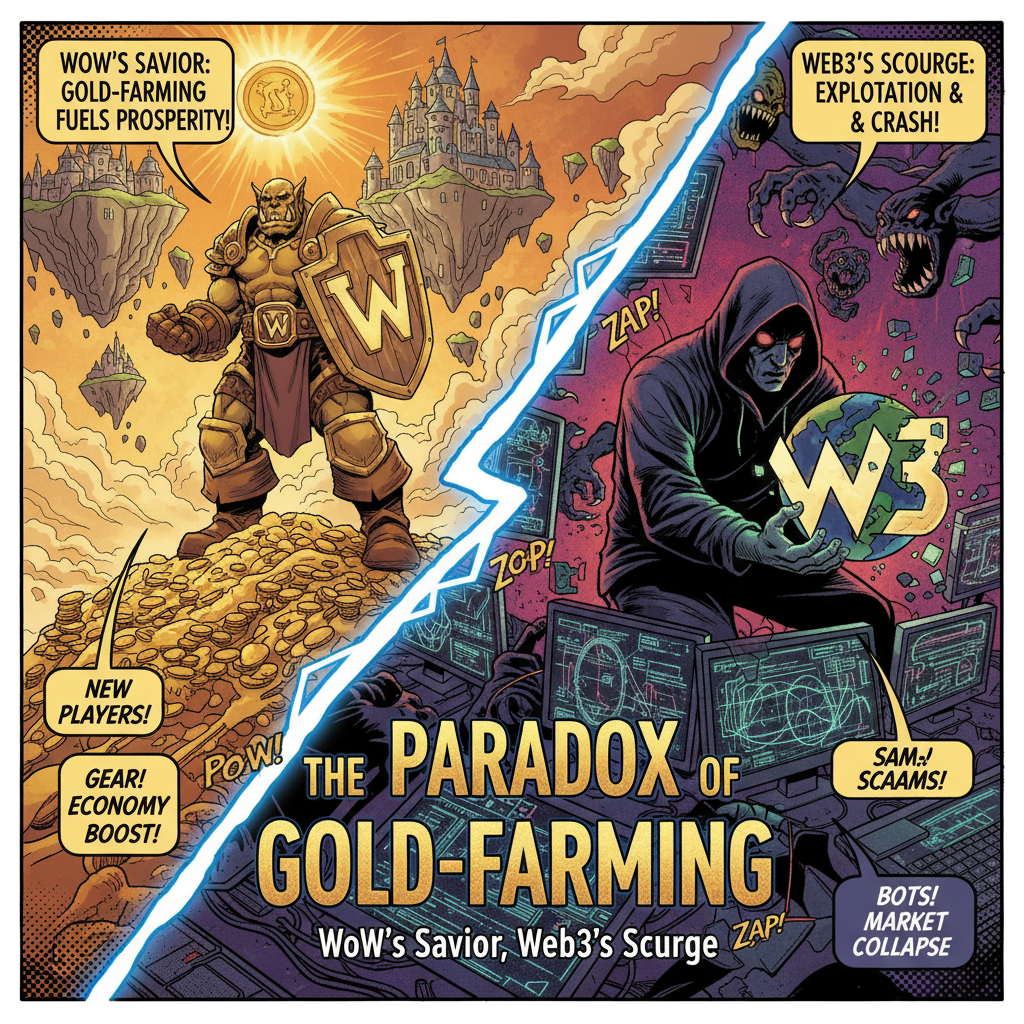
Ever wonder why gold-farming kept World of Warcraft alive for years, yet the same tricks seem to “kill” every Web3 game? It’s a big puzzle in gaming history. World of Warcraft (WoW) lasted over 20 years as a top game. Gold farmers – big teams making in-game gold to sell for real cash – played a key role. But in blockchain games, gold farming leads to quick crashes. Why the difference? Let’s break it down.
This story shows big lessons for crypto gaming. It mixes old-school MMORPG success with new Web3 fails. If you’re into blockchain, play-to-earn (P2E), or game economies, read on.
What Are Gold-Farming Studios?
Gold farming means players grind for in-game items or currency, then sell them for real money. Studios are professional operations, often in China or Southeast Asia. They hire hundreds of workers or use bots to farm 24/7.
In WoW, gold farmers leveled low-skill characters in easy zones. They sold gold on black markets or sites like PlayerAuctions. One studio might control thousands of accounts. Blizzard hated it and banned millions of accounts. But did it hurt WoW? Not really – it helped.
- Scale: Studios ran like factories with shifts and quotas.
- Tools: Bots, VPNs, and cheap labor kept costs low.
- Market: Casual players bought gold to skip grind and enjoy end-game raids.
How Gold Farming Kept WoW Alive
WoW launched in 2004 and peaked at 12 million players. Gold farming started early. By 2005, it was huge. Blizzard fought it with patches, wardens, and lawsuits. Yet WoW subscriptions stayed high. Here’s why gold farmers were a secret boost:
- Player Retention: Hardcore players loved the grind. Casuals hated it. Gold buying let newbies jump in fast. This kept servers full and communities alive.
- Real Economy: Gold had street value. $1 bought 100-200 gold early on. This created a player-driven market bigger than official auctions.
- Content Demand: Farmers needed gear and levels too. They bought from legitimate players, boosting crafting and trading.
- Blizzard Profits: More active accounts meant more subscriptions. Even banned farmers bought new ones. WoW earned billions.
Proof? WoW expansions like Wrath of the Lich King sold 4 million copies day one in 2008 – peak farming era. Game stayed top dog till 2010s.
The Web3 Gaming Boom and Bust
Web3 games use blockchain for true ownership. NFTs for items, tokens for rewards. Play-to-earn exploded in 2021. Axie Infinity hit 2.7 million daily users. Sky Mavis made $1.2 billion. Others like The Sandbox, Decentraland promised riches.
But most died fast. SLP token from Axie crashed 99% from peak. Players quit. Why? Gold farming hit harder here.
Why Gold Farming “Killed” Web3 Games
In WoW, gold was infinite but server-locked. Farming took human time or smart bots. Real money trade (RMT) was a side hustle.
Web3 changes everything:
- Tokens Are Money: SLP, AXS, SAND have real value on exchanges. Farm 1000 tokens? Sell instantly for USD.
- No Limits: Bots run wild. No cooldowns like WoW skills. One script farms forever.
- Inflation Explosion: Studios pump millions of tokens. Supply floods market. Price tanks. Real players can’t earn.
- Bad Incentives: Why play for fun when bots win? Games become spreadsheets.
Axie example: In 2021, Vietnamese studios farmed with thousands of accounts. SLP supply jumped. Price fell from $0.40 to $0.003. Users dropped 95%. Others like Gods Unchained, Alien Worlds saw same bot plagues.
| Game | Peak Users | Token Crash | Farming Impact |
|---|---|---|---|
| Axie Infinity | 2.7M daily | 99% | Bot farms killed economy |
| Yield Guild Games | Hundreds of K | 95% | Scholar bots flooded |
| Illuvium | Promised big | ILV down 80% | Early bot tests hurt hype |
Key Differences: WoW vs Web3 Economies
Why one thrived, other crashed?
- Central Control: Blizzard patched farms, reset economies. Web3 is decentralized – hard to stop bots.
- Value Type: WoW gold unofficial. Web3 tokens official and liquid.
- Player Goals: WoW for fun/social. Web3 for earn – fragile when yields drop.
- Tech: WoW client-side checks. Blockchain public – easy exploits.
WoW had farmers as parasites that fed the host. Web3? Parasites ate the host alive.
Lessons for Blockchain Gaming Future
Web3 isn’t dead. Fixes exist:
- Anti-Bot Tech: Proof-of-skill, AI detection, soulbound tokens.
- Hybrid Models: Fun first, earn second. Like Pixels or Parallel.
- Capped Supply: Burn mechanisms, staking locks.
- Community Tools: Player reports, guild bounties on farms.
- Regulated RMT: Official gold shops like in some MMOs.
Games like Off The Grid or Shrapnel test these. Blockchain can win if it copies WoW smarts.
Conclusion
Gold farmers were heroes and villains. They kept WoW alive by fueling its economy. But they “killed” Web3 games by breaking fragile token systems. The lesson? Sustainable design beats hype. Fun games last. Pure P2E? Gold farmers feast.